Everything in the 1996 Pokémon Carddass vending set, the first Pokémon card set
The 1996 Pokémon Carddass vending set is 158 cards sold from Bandai's machines in two parts, Part 1 from 21 to 30 September 1996 and Part 2 from 1 to 10 October, with every Pokémon card printed in a red and a green version. Three title cards, 151 Pokémon of which twelve are prisms, and four checklists. This is what each of them is, which exist in one colour only, and how the two versions are told apart.
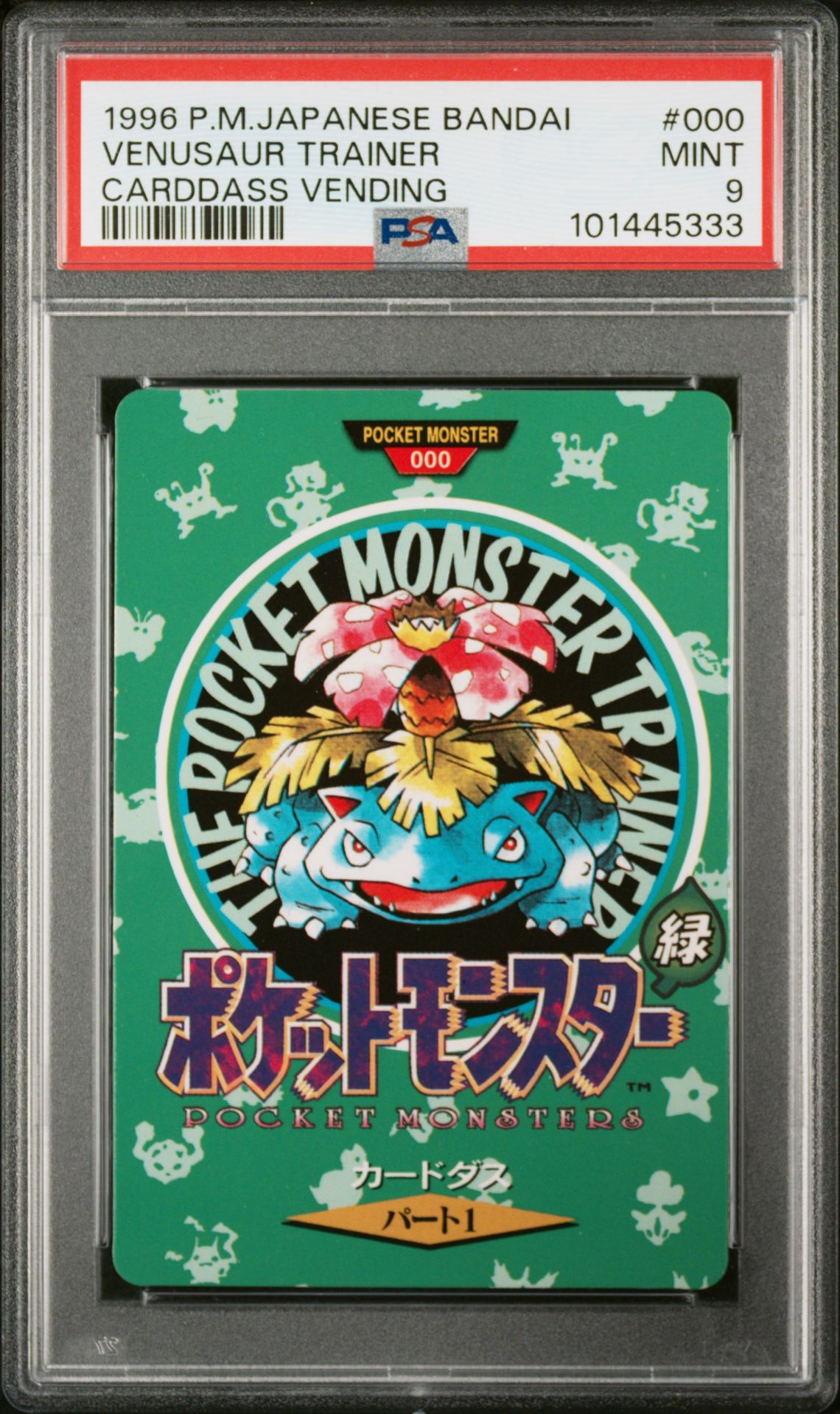
Bandai printed 151 Pokémon cards, three title cards and four checklist cards for its Carddass machines in the autumn of 1996, and printed every Pokémon card twice, once with a red banner and once with a green one, so a complete run is 309 cards. Bulbapedia's page on the set puts Part 1 on sale between 21 and 30 September 1996 and Part 2 between 1 and 10 October, on the strength of an advertisement on page 154 of the October 1996 CoroCoro Comic, which went on sale on 15 September. That is the whole set. The rest of this page goes through it part by part and card type by card type, and ends with the one thing the cards carry that PSA's label does not.
Two parts, sold three weeks apart
Carddass is Bandai's name for its card vending line, the same machines that sold its Dragon Ball and Gundam cards. Bulbapedia records two machine types for the Pokémon cards: one dispensing a single card for 20 yen, the other a stack of five for 100 yen, the five held together by a loop of white paper. The cards measure 59 by 86 millimetres, a little smaller than a trading card game card at 63 by 88, and they are not game cards: no attacks, no hit points, nothing to play. The front carries Ken Sugimori's watercolour art of the Pokémon, the same art used across the early merchandise. The back carries data from the Red and Green games, the original sprite, a bar for the Pokémon's height, and how common it is in each game, with the box filled in as water for a Pokémon that can only be fished up. The name itself refers to AMeDAS, Japan's automated weather data network: the idea, per Bulbapedia, was a card whose back is data.
| Card type | Part 1 | Part 2 | Both |
|---|---|---|---|
| Title card | Part 11 | Part 21 | Both2 |
| Title card EX | Part 10 | Part 21 | Both1 |
| Pokémon cards, plain | Part 169 | Part 270 | Both139 |
| Pokémon cards, prism | Part 16 | Part 26 | Both12 |
| Checklist cards | Part 12 | Part 22 | Both4 |
| Distinct cards | Part 178 | Part 280 | Both158 |
| Counting red and green | Part 1153 | Part 2156 | Both309 |
The two parts between them show all 151 of the original Pokémon once each. Part 1 is the first 75 Pokémon in Bulbapedia's set order, Bulbasaur to Pinsir, with the Pokémon exclusive to the Green game folded in. Part 2 is the remaining 76, Weedle to Mew, with the Red exclusives. A Pokémon's number on the card is its Pokédex number, so Pikachu is 25 in Part 1 and Mewtwo is 150 in Part 2, and the checklist on the back of each Pokédex card lists the part's Pokémon in that order.
Red and green are versions of each card, not the two parts
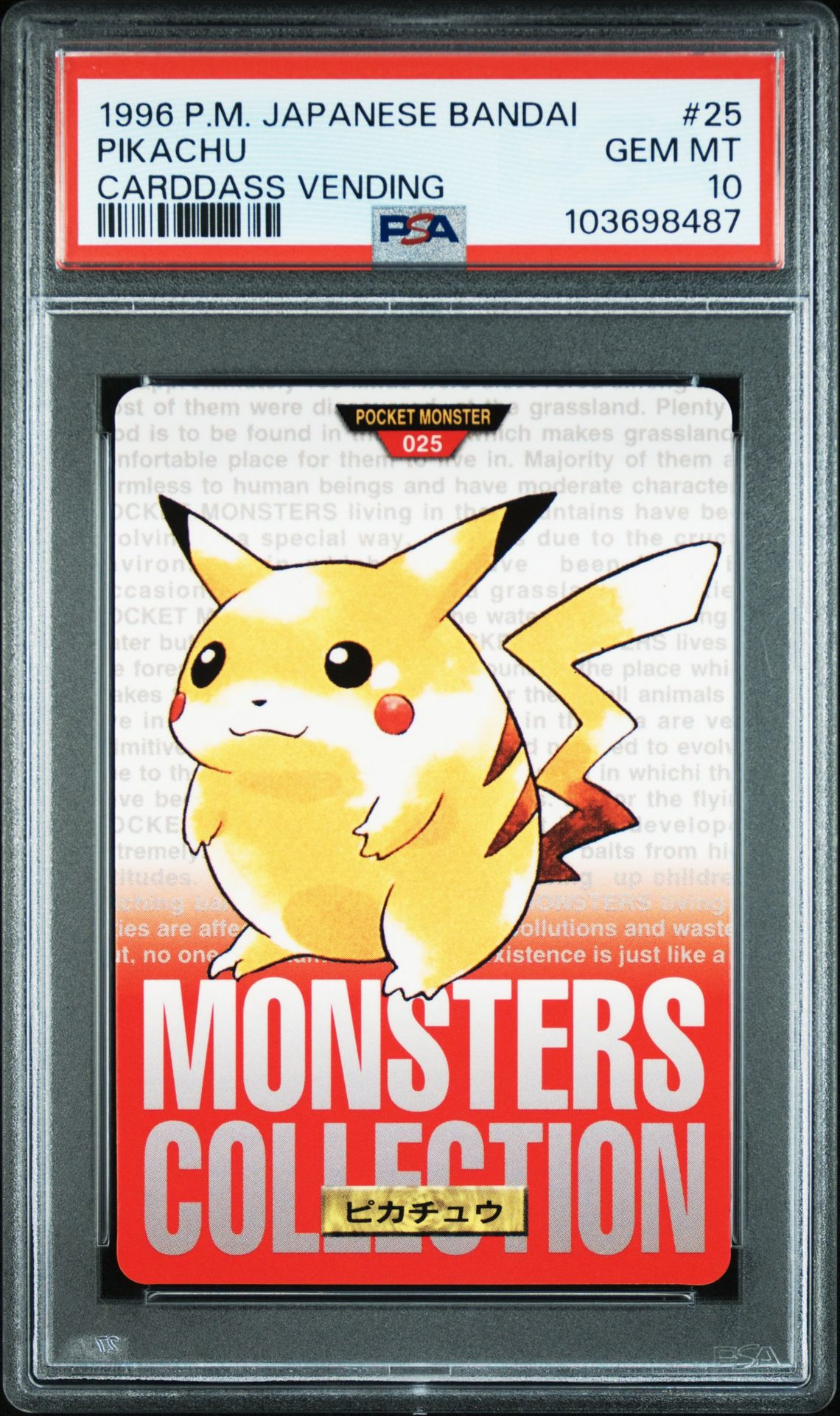
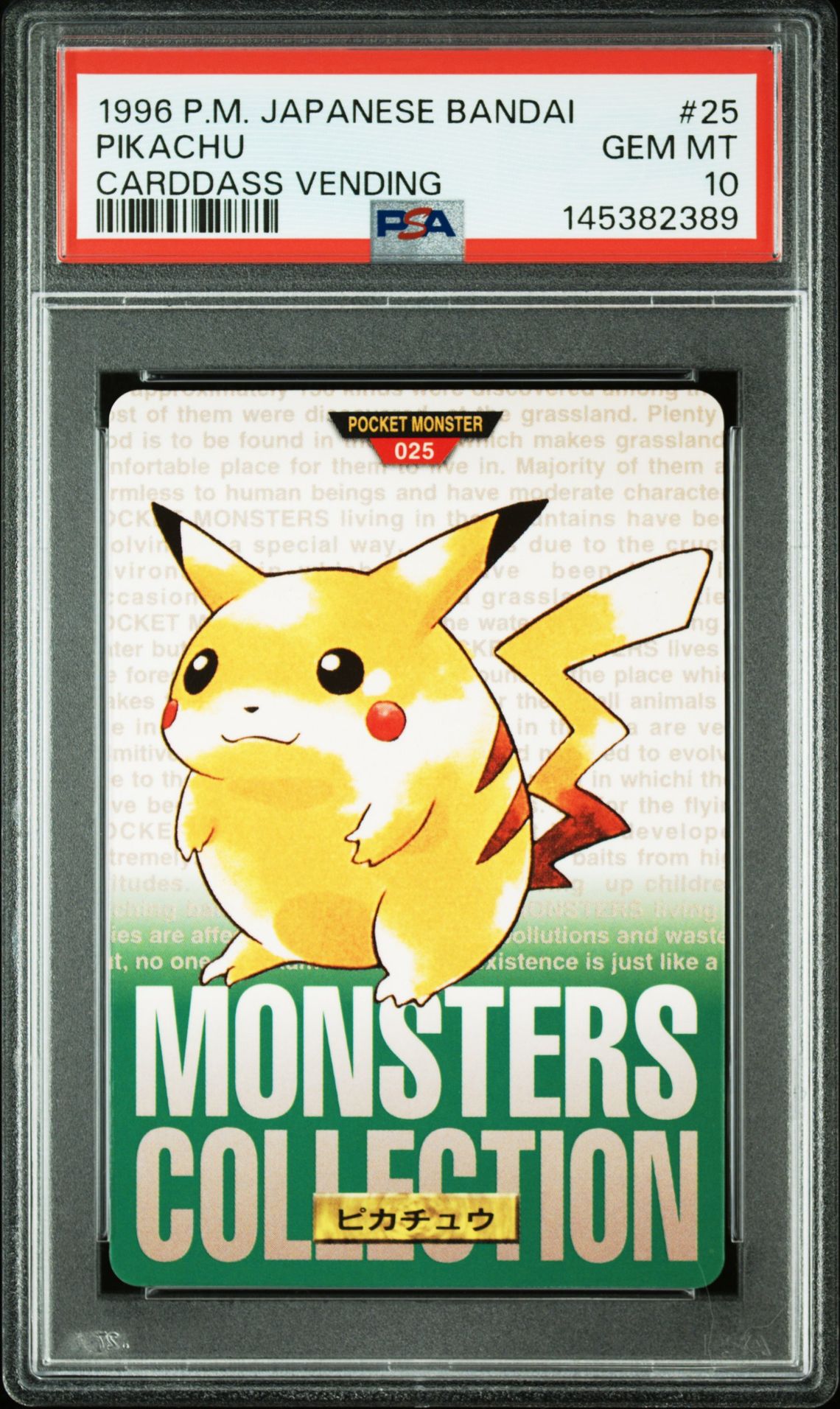
Every Pokémon card in both parts was printed in two versions, named for the two Game Boy games. The art, the number and the text are the same; the Monsters Collection banner across the foot of the card is red on one and green on the other. Bulbapedia notes that some collectors once took the green cards to be Part 1 and the red cards to be Part 2, because the Part 1 vending display, map card and checklist cards are all green. The display on the machine itself says otherwise. It lists both colours of every Part 1 Pokémon, using Pikachu as the example, and the same sources say the same of Part 2's 76. A red Pikachu and a green Pikachu are both Part 1 cards.
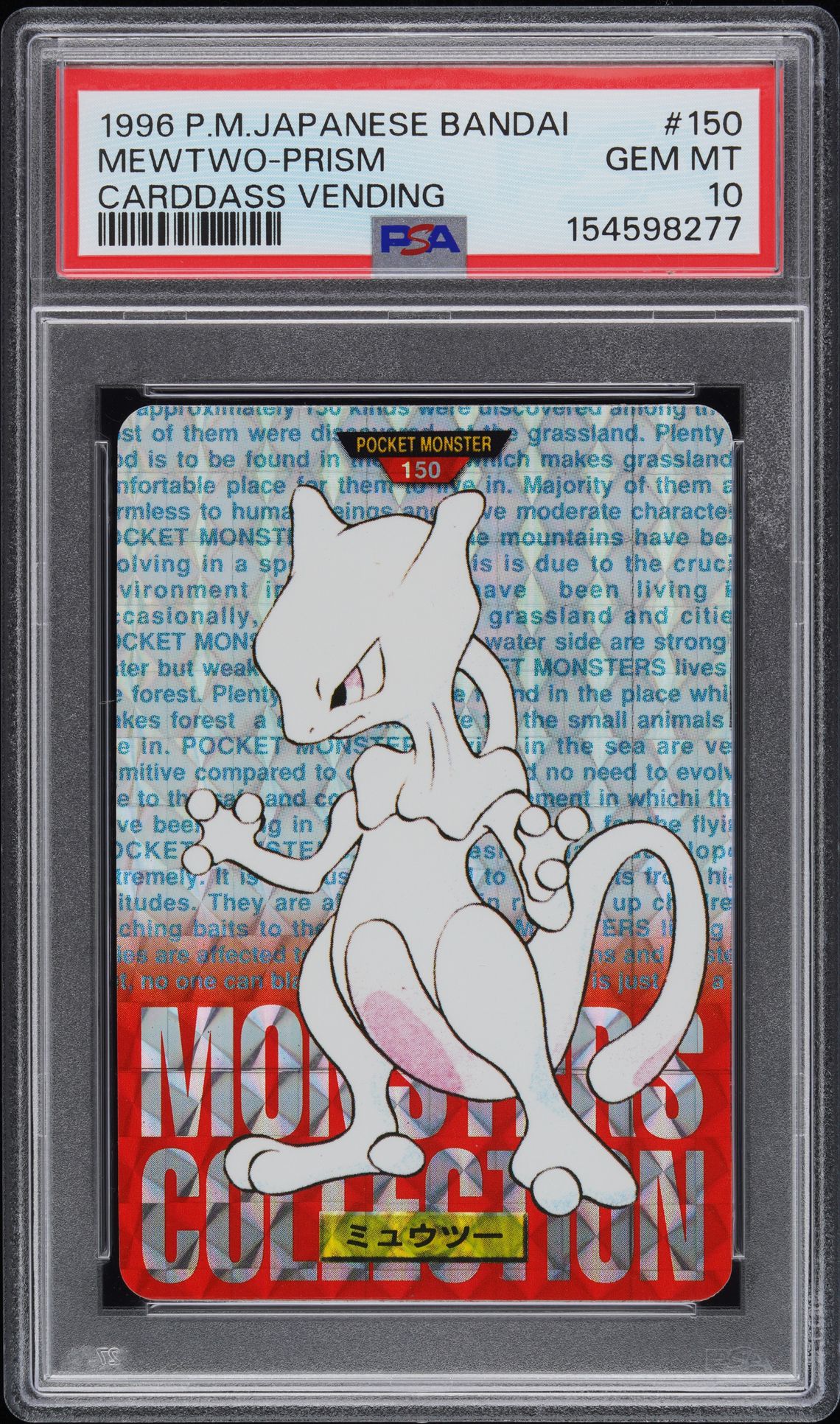
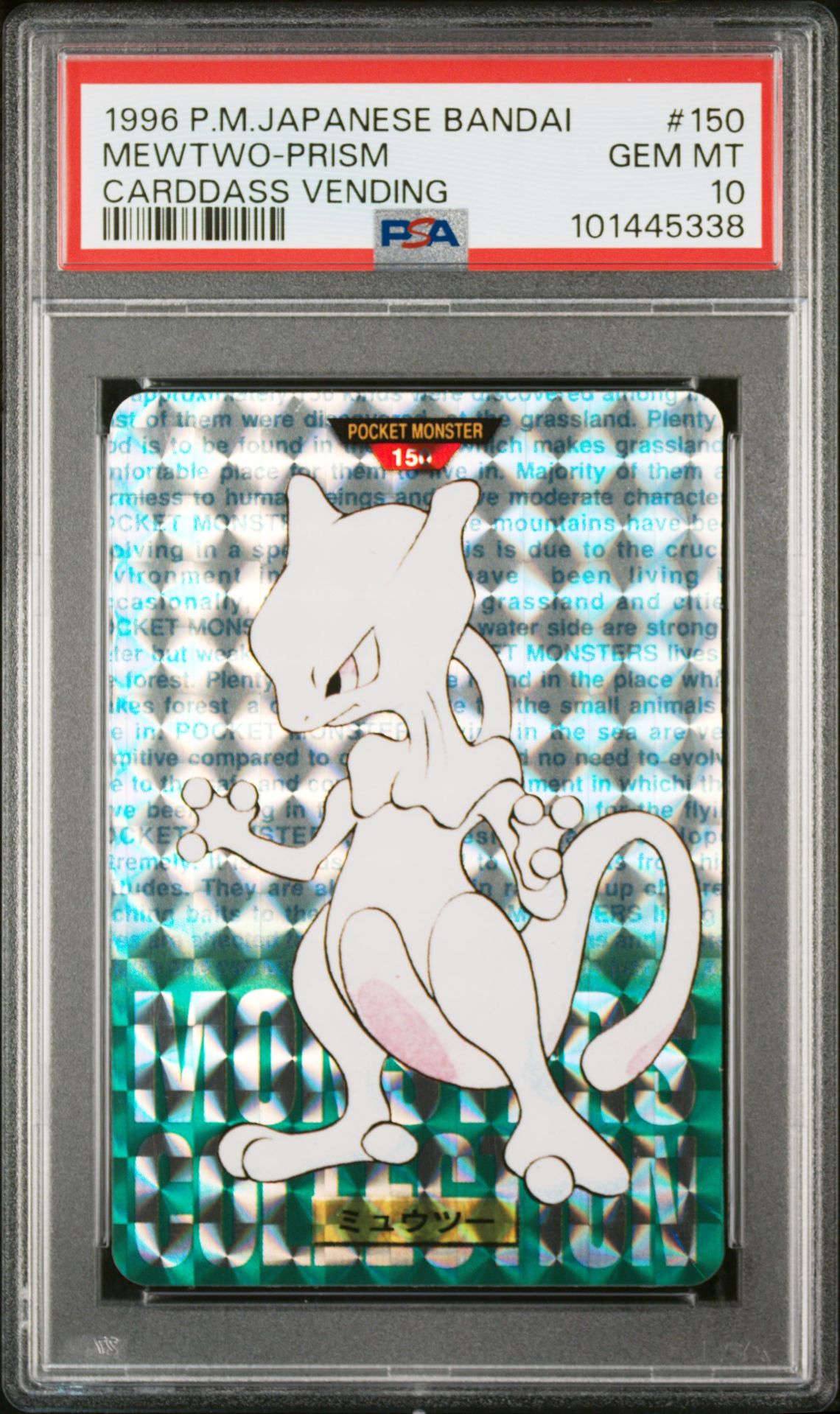
The banner is the only reliable marker. The foil on a prism refracts the whole card towards whatever light is on it, so a photographed prism can look warm or cool, and the printed text is not a marker either. The Machamp and Gengar cards carry the line EXCHANGED from GREEN VERSION in their text, which is card copy about trading between the two games, and it is printed on the red and the green card alike. A listing that calls a card green because of that line has read the copy, not the banner.
The twelve prisms are the set's holographic cards
Six cards in each part are printed on a holographic foil. Carddass sets call them prism cards, プリズムカード, and Bulbapedia records one physical oddity: the front of a prism can be peeled off like a sticker, leaving the back on the card, while the title and plain cards do not peel. The 2023 Elite Fourum guide to the set by maxmaxcity describes the foil as delicate and easily scratched, and its author believes the small nick found at the bottom right corner of many cards in the set comes from the dispensing machine. Part 1's prisms are the three final starters and three of the Part 1 evolutions; Part 2's are Gengar, the three legendary birds, Mewtwo and Mew.
| Card | Part | Graded | PSA 10 | Gem rate |
|---|---|---|---|---|
| #3 Venusaur | PartPart 1 | Graded1,103 | PSA 1060 | Gem rate5.4% |
| #6 Charizard | PartPart 1 | Graded2,085 | PSA 10113 | Gem rate5.4% |
| #9 Blastoise | PartPart 1 | Graded1,258 | PSA 10106 | Gem rate8.4% |
| #65 Alakazam | PartPart 1 | Graded837 | PSA 1077 | Gem rate9.2% |
| #68 Machamp | PartPart 1 | Graded680 | PSA 1076 | Gem rate11.2% |
| #76 Golem | PartPart 1 | Graded604 | PSA 1073 | Gem rate12.1% |
| #94 Gengar | PartPart 2 | Graded1,463 | PSA 1074 | Gem rate5.1% |
| #144 Articuno | PartPart 2 | Graded1,008 | PSA 1090 | Gem rate8.9% |
| #145 Zapdos | PartPart 2 | Graded1,028 | PSA 1079 | Gem rate7.7% |
| #146 Moltres | PartPart 2 | Graded1,013 | PSA 1063 | Gem rate6.2% |
| #150 Mewtwo | PartPart 2 | Graded1,399 | PSA 10106 | Gem rate7.6% |
| #151 Mew | PartPart 2 | Graded1,302 | PSA 1084 | Gem rate6.5% |
The prisms were not short-printed. Bulbapedia cites a filmed opening of a sealed Part 1 box by the YouTuber Tsunagu: 200 cards, with exactly two of each prism, one red and one green, two title cards, one of each plain card, one Pokédex card, and 48 duplicate plain cards. A Part 2 box opened the same way held one of each prism again, with two Blastoise and three Charizard title cards. On that structure a prism is as common as a title card and only about 1.35 times rarer than a plain card. What makes a PSA 10 prism scarce is the foil, not the print run: PSA has graded 13,780 prisms and given 1,001 of them a 10, a rate of 7.3%, against 12.6% for the plain cards. What the prisms sell for is in the price report.
Seven cards exist in one colour only
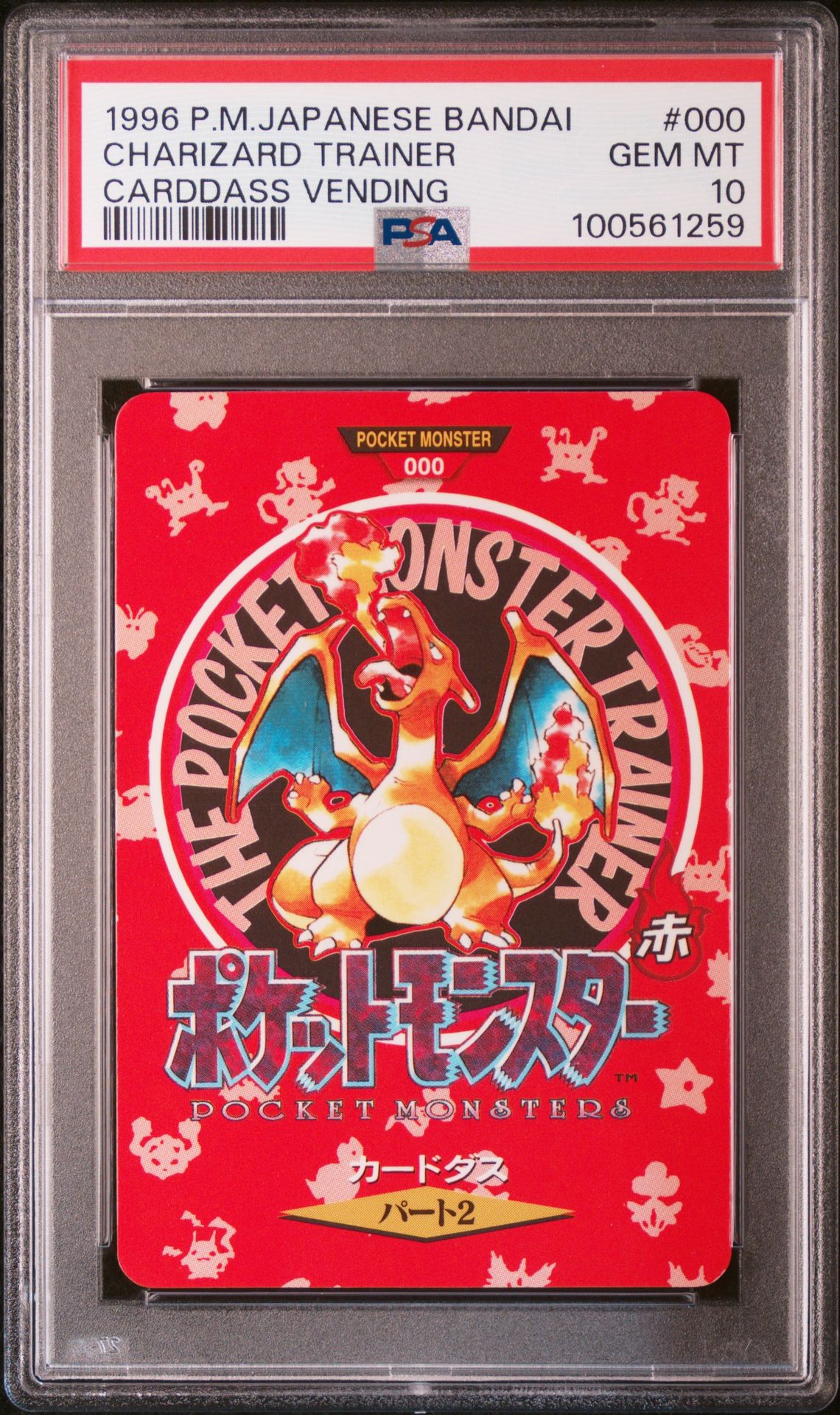
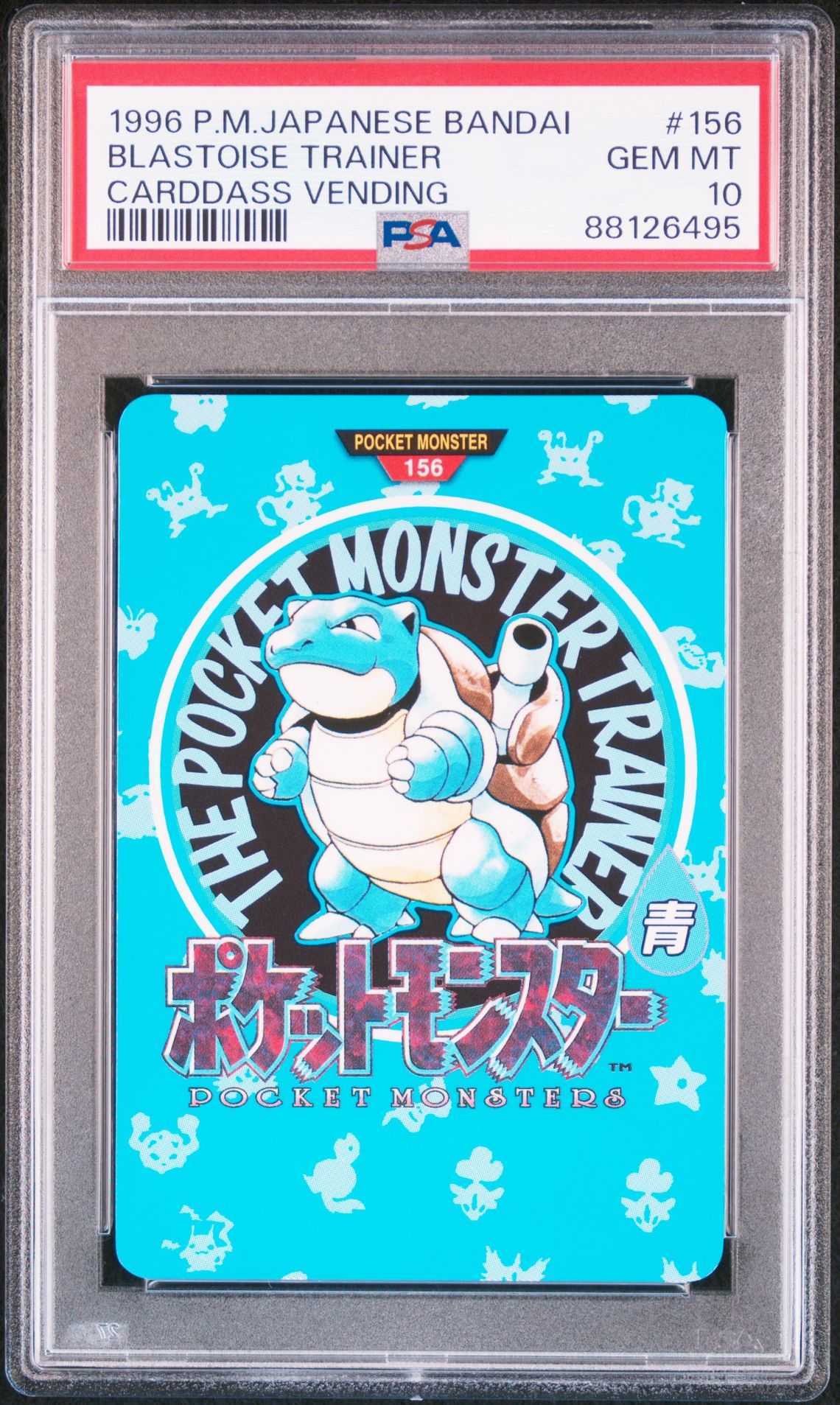
PSA has seen these in numbers. As of 4 October 2026 the Charizard title card has been graded 785 times with 15 PSA 10s, the Venusaur 401 times with 4, and the Blastoise EX 528 times with 11. The checklists are rarer in slabs, 50 to 67 graded each and 1 to 3 in PSA 10. Because they have no red and green, the census shows each of the seven as one version and never splits it.
The 139 plain cards carry the same two versions
Everything said of the prisms' colours holds for the plain cards, which are the bulk of the set. The front is a white panel of English text about Pokémon in general behind the Sugimori art, with the Monsters Collection banner in red or green at the foot and the Pokémon's Japanese name in a gold box. Eleven cards have an extra illustration on the back by Benimaru Itoh, per Bulbapedia: Arbok, Pikachu, Jigglypuff, Poliwhirl, Geodude, Slowbro, Doduo, Gengar, Drowzee, Horsea and Kabutops; the Pikachu's shows it held down and measured with a multimeter. Pikachu is also the plain card PSA has graded most, 697 times to 4 October 2026, more than twice the next (Gyarados and Snorlax, 308 each), with 80 in PSA 10.
What the dates rest on
The cards carry no date. Bulbapedia's dating comes from three Japanese sources of the time: the September 1996 Carddass News Magazine, whose list of the month's new products ends with Pocket Monsters Part 1; the CoroCoro advertisement already mentioned, whose margin reads 9月下旬発売, on sale in late September, with Part 2 promised for early October at the foot of the page; and the cardboard displays on the machines, which list each part's cards and show both colours. Where the Carddass cards sit against the CoroCoro glossy Pikachu of 15 October 1996 and the Base Set of 20 October is the subject of its own report, and is not repeated here.
The set in five questions
- How many cards are in the 1996 Pokémon Carddass vending set?
- 158 distinct cards across Part 1 (78) and Part 2 (80): three title cards, 139 plain Pokémon cards, 12 prisms and four checklists. Counting the red and green printing of every Pokémon card, 309.
- When was the 1996 Bandai Carddass Pokémon set released?
- Part 1 between 21 and 30 September 1996 and Part 2 between 1 and 10 October 1996, per the CoroCoro advertisement of 15 September 1996 that Bulbapedia cites. The cards were sold from Carddass vending machines at 20 yen a card or 100 yen for five.
- Which Carddass cards are prisms?
- Twelve. Venusaur, Charizard, Blastoise, Alakazam, Machamp and Golem in Part 1; Gengar, Articuno, Zapdos, Moltres, Mewtwo and Mew in Part 2. Each exists in red and green. PSA had graded 13,780 of them by 4 October 2026, 1,001 in PSA 10.
- Is a green Carddass card from Part 1 and a red one from Part 2?
- No. Both parts contain both versions of every Pokémon card; the machine displays list each part's cards in both colours. Only the title and checklist cards are one colour: Part 1's are green, Part 2's red, and the Blastoise Title card EX is blue.
- How do you tell a red Carddass card from a green one?
- By the Monsters Collection banner across the foot of the card, which is red on one version and green on the other. The art, the number and the text do not change, and the "exchanged from green version" line on Machamp and Gengar appears on both.
Every card in the set has a page, from the Part 1 title card to Mew, with its PSA population and every attributed copy by colour; the sales we hold are on the sales page, filterable by card. A cert that is not there yet can be added with a photo.
Check the figures yourself
Every sale in this report is on the sales page, and every attributed cert is on its card page with its photo.